



How long is a Jiu-Jitsu match?
In the adult division, match time goes from five minutes at white belt to ten at black; see the IBJJF chart by age and belt and the minimum rest between matches

A Jiu-Jitsu match can end in a few seconds, if there is a submission, or last up to ten minutes, in the case of adult black belts. The regulation time is set by the rule book of the IBJJF, the sport’s international federation, and changes according to the athlete’s age and belt.
The chart applies to IBJJF gi and no-gi championships and is used as a reference by many other federations.
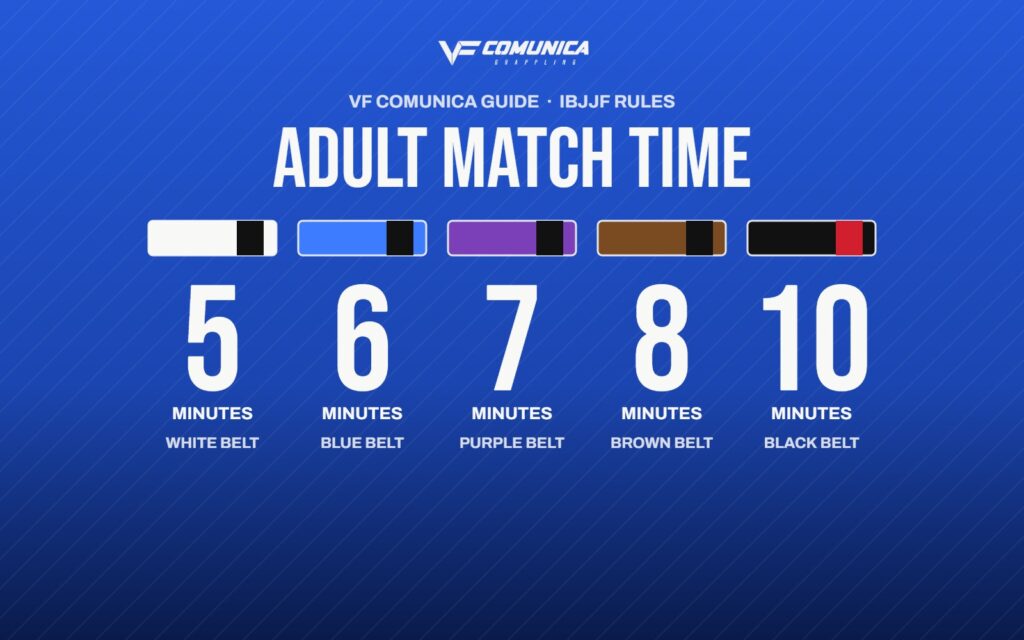
Adult match time
| Belt | Match time |
|---|---|
| White | 5 minutes |
| Blue | 6 minutes |
| Purple | 7 minutes |
| Brown | 8 minutes |
| Black | 10 minutes |
The adult division starts at age 18. With each belt the match gets one minute longer, with a two-minute jump from brown to black.
Kids and juveniles
| Division | Age | Match time |
|---|---|---|
| Mighty Mite | 4 to 6 | 2 minutes |
| Pee Wee | 7 to 9 | 3 minutes |
| Junior | 10 to 12 | 4 minutes |
| Teen | 13 to 15 | 4 minutes |
| Juvenile | 16 and 17 | 5 minutes |
The IBJJF calculates age by year of birth: what counts is the age the athlete turns in the year of the championship, even if the birthday has not arrived yet. In the juvenile division, matches last five minutes at every belt.

Master match time
| Division | Age | Match time |
|---|---|---|
| Master 1 | 30 and over | 5 minutes at white and blue; 6 minutes at purple, brown and black |
| Master 2 to Master 7 | 36 and over | 5 minutes at every belt |
The master division is split into seven age groups. Master 2 starts at 36, Master 3 at 41, Master 4 at 46, Master 5 at 51, Master 6 at 56 and Master 7 at 61.
The match can end early
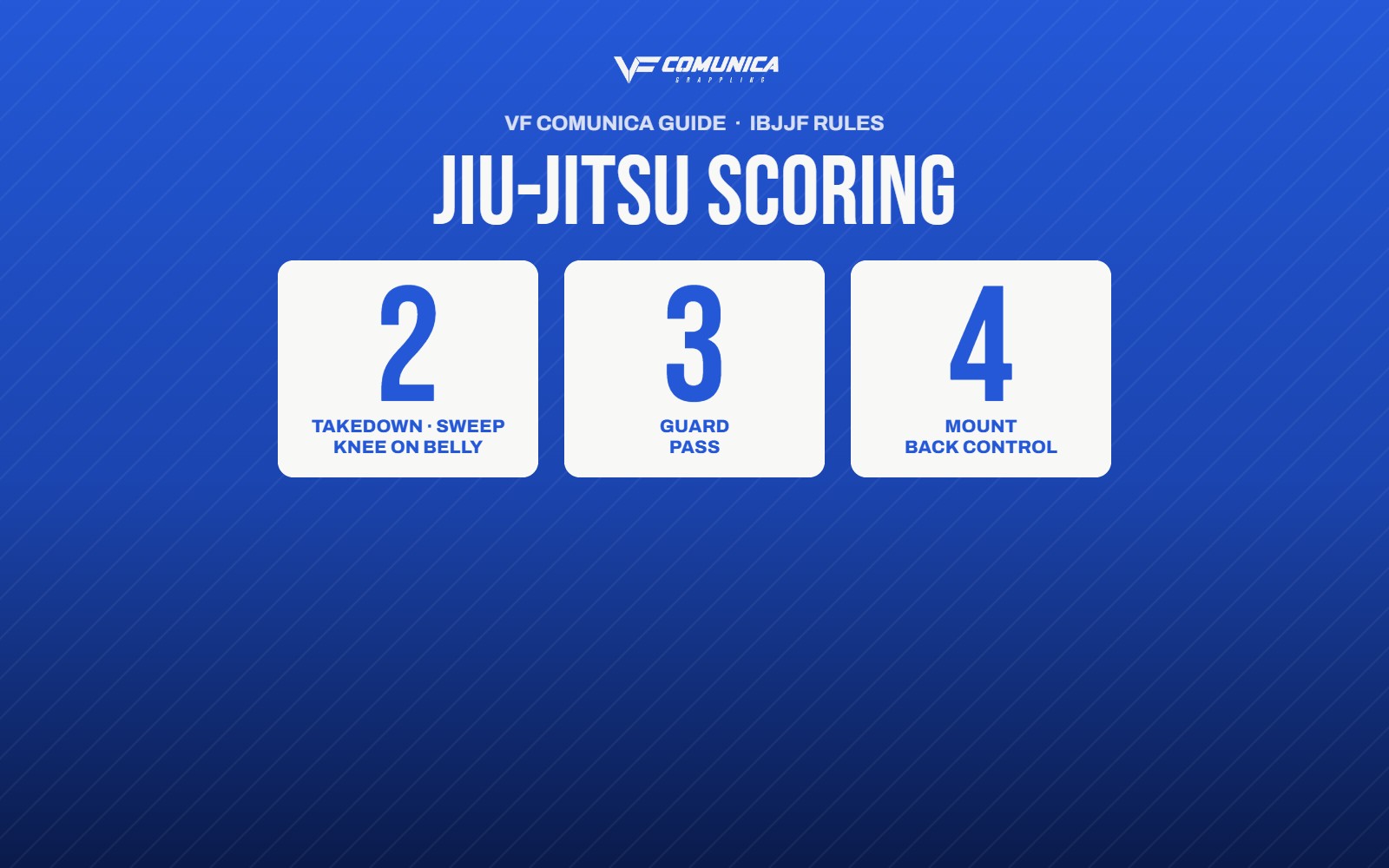
The clock only runs out when nobody gets a submission. A match also ends early by disqualification, referee stoppage or loss of consciousness. If time expires, the result comes from the scoreboard, with points, advantages and penalties. VF Comunica explains how many points each position is worth in another guide.
Time also shapes strategy. Whoever is ahead on the scoreboard cannot simply hold the opponent: the referee penalizes an athlete who goes 20 consecutive seconds without trying to progress, which is known as stalling.
Rest between matches
The rules guarantee a minimum break between matches for the same athlete. Up to the semifinals, the rest equals the regulation time of the division. Before the finals, it is double. An adult black belt, for example, is entitled to at least ten minutes between matches and 20 minutes before the final.
What about professional events?
Invitationals and superfights have their own rules and may use match times different from the IBJJF chart. It is worth checking each event’s rules before watching or competing.
Is ten minutes the right match time for black belts? Leave your opinion in the comments.