



What is the ADCC: rules, weight classes, trials and the greatest champions
Created in 1998 in Abu Dhabi, the submission grappling world championship happens every two years, has 16 athletes in each men’s division and scores differently from the IBJJF, with a negative point for pulling guard

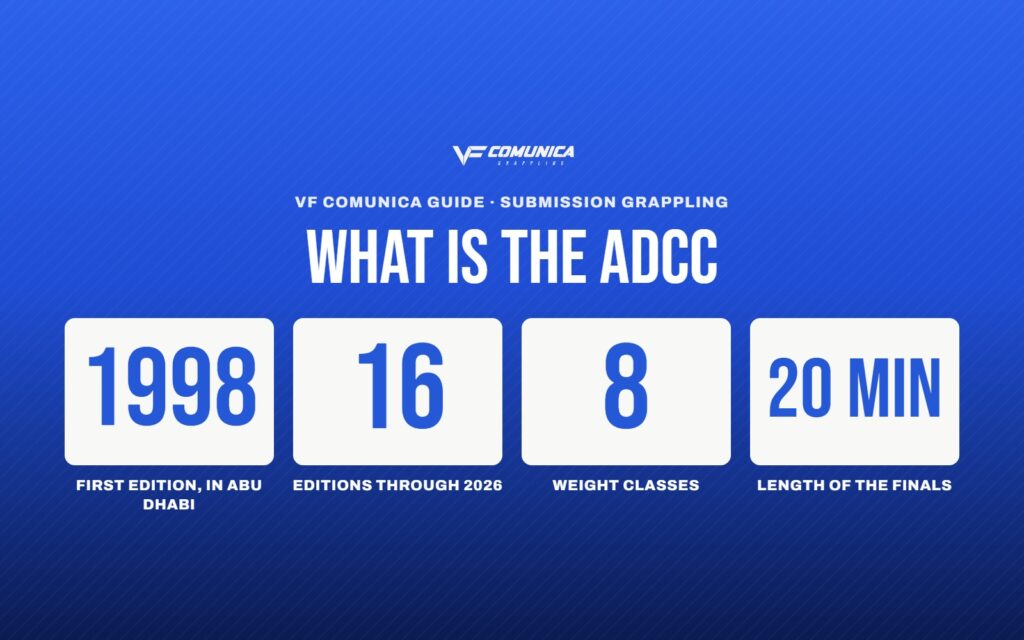
The ADCC is the most important no-gi submission grappling tournament in the world. The name stands for Abu Dhabi Combat Club, the club founded by Sheikh Tahnoon Bin Zayed Al Nahyan of the United Arab Emirates, which held the first edition on March 20–22, 1998, in Abu Dhabi.
The tournament was held every year until 2001 and then moved to every two years. It is open to athletes from any grappling style, from Jiu-Jitsu to wrestling, and has its own rules, different from the IBJJF’s.
How an athlete gets into the ADCC
In 2026, each of the five men’s divisions had 16 athletes and each of the three women’s divisions had eight. The spots come from three paths: regional trials, invitations from the organization and the champions of the previous edition.
The trials are split into four regions: Europe, the Middle East and Africa; North America; South America; and Asia and Oceania. Each region usually holds two trials per cycle, and the champion of each division earns the spot. Athletes need a passport from a country in the region.

Weight classes
| Men | Women |
|---|---|
| Under 66 kg (145 lb) | Under 55 kg (121 lb) |
| Under 77 kg (170 lb) | Under 65 kg (143 lb) |
| Under 88 kg (194 lb) | Over 65 kg |
| Under 99 kg (218 lb) | |
| Over 99 kg |
The three women’s divisions have been in place since the 2024 World Championship. Before that, women competed in two divisions, under 60 kg and over 60 kg. Besides the weight classes, the event has the absolute, with no weight limit, and the superfight, which usually matches the previous superfight winner against the last absolute champion.
Rules and scoring
In the elimination rounds, a match lasts 10 minutes and the first five have no points. In the finals and the superfight it is 20 minutes, and in the first ten only negative points count. A tied match goes to overtime and, if nobody scores, the referees decide.
| Position | Points |
|---|---|
| Guard pass | 3 |
| Back mount with hooks | 3 |
| Mount | 2 |
| Knee on belly | 2 |
| Takedown | 2, or 4 if the athlete lands past the guard |
| Sweep | 2, or 4 if it ends past the guard |
The position has to be held for three seconds. The biggest difference from IBJJF scoring is the negative points: an athlete loses a point for pulling guard or sitting down and staying on the mat for three seconds, and also for being warned for passivity.
Submissions are more open. All leg locks and foot locks are legal, heel hooks included, and slams are allowed when the athlete is caught in a submission. Under IBJJF rules, both are illegal in the gi.
Where the ADCC has been held
| Year | Host |
|---|---|
| 1998 to 2001 | Abu Dhabi, United Arab Emirates |
| 2003 | São Paulo, Brazil |
| 2005 | Long Beach, United States |
| 2007 | Trenton, United States |
| 2009 | Barcelona, Spain |
| 2011 | Nottingham, England |
| 2013 | Beijing, China |
| 2015 | São Paulo, Brazil |
| 2017 | Espoo, Finland |
| 2019 | Anaheim, United States |
| 2022 | Las Vegas, United States |
| 2024 | Las Vegas, United States |
| 2026 | Kraków, Poland |
The 2021 edition was postponed to 2022. Brazil is the country with the most titles: 89, according to the official statistics, against 24 for the United States.
The greatest champions
At the first edition, four Brazilians won titles: Alexandre “Soca” Freitas, Renzo Gracie, Rodrigo Gracie and Mario Sperry, who took his weight class and the absolute.
The most successful athlete is American Gordon Ryan, with three weight titles, in three different divisions, one absolute and three superfights. André Galvão won his weight class and the absolute in 2011 and then four superfights in a row, from 2013 to 2019. Marcelo Garcia has four titles at under 77 kg, the same number as Gabi Garcia among the women and as Kaynan Duarte.
In 2026, in Kraków, Felipe Pena became the first two-time absolute champion in history, and Yuri Simões won the superfight for his fourth title at the tournament. Helena Crevar, at 19, became the youngest women’s champion, and Pawel Jaworski gave Poland its first gold.
How much the ADCC pays
In 2026, the champion of each men’s division received US$20,000, the champion of each women’s division US$10,000, and the absolute and superfight winners US$50,000 each. A comparison with other events is in the guide to prize money in Jiu-Jitsu.
Who is the greatest champion in ADCC history? Leave your opinion in the comments.