



Illegal moves in Jiu-Jitsu: what each belt cannot do
The IBJJF chart lists 26 techniques banned by age and belt; heel hooks are legal only for adult brown and black belts in no-gi, and using an illegal move means immediate disqualification

Slams, neck cranks and the scissor takedown are illegal for every athlete at an IBJJF tournament. Knee bars, toe holds and bicep slicers depend on the belt and are only allowed from brown belt up. The full list is in the federation’s rule book, which most tournaments around the world use as a reference.
The chart has 26 items and is split by age and by belt. Here is what each athlete can and cannot do under the current version of the rules.
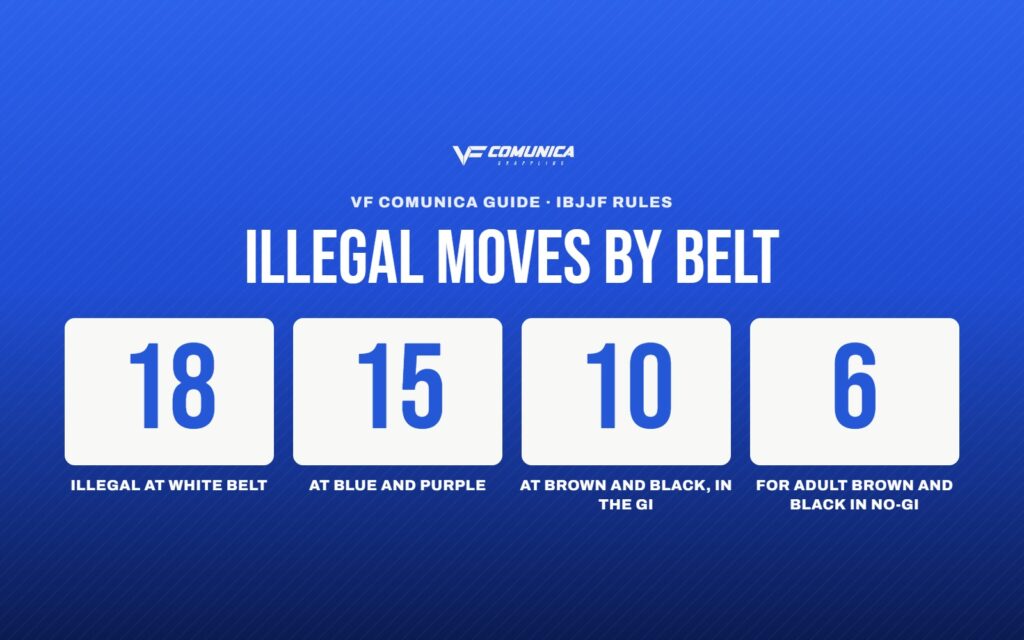
How many moves are illegal at each belt
| Belt (adult) | Illegal moves |
|---|---|
| White | 18 |
| Blue and purple | 15 |
| Brown and black, gi | 10 |
| Brown and black, no-gi | 6 |
Athletes aged 16 and 17 follow the white belt list, whatever their rank. For kids, the chart is even stricter.
Illegal for everyone
Six moves are banned at every age and belt, gi or no-gi, black belts included:

- Slam
- Spinal lock without a choke (neck crank)
- Scissor takedown
- Bending the opponent’s fingers backwards
- Grabbing the opponent’s belt and throwing him head-first to the mat while defending a single leg
- Suplex that drops the opponent on his head or neck
White belt
On top of those six, white belts cannot use wrist locks or any lock that squeezes the ribs or kidneys from inside the closed guard. The chart also lists the single leg takedown with the head on the outside, with a note from the rule book itself: it is an illegal technique, but the athlete is not penalized for it.
White belts cannot jump to closed guard either. That one is treated as a serious foul, not as an illegal move. The same rule applies to every athlete aged 15 and under.
Every move banned for the higher belts is also illegal at white belt.
Blue and purple belts
At blue and purple, wrist locks become legal. Five attacks stay banned and only open up at brown belt:
- Bicep slicer
- Calf slicer
- Knee bar
- Toe hold
- In a straight foot lock, turning toward the foot that is not being attacked
Brown and black belts
Brown and black belts can attack the knee, bicep, calf and foot. In the gi, four items are still banned even for them:
- Heel hook
- Any lock that twists the knee
- Knee reaping
- In a toe hold, applying pressure toward the outside of the foot
In no-gi, the rule changes. Those four moves are legal for adult brown and black belts. The exception covers the adult division only: in the master divisions they stay illegal even without the gi. The differences between the two formats are in another VF Comunica guide.
Kids and teens
From ages 4 to 12, any submission position that forces the legs apart is illegal. From 4 to 15, the list also includes chokes that put pressure on the neck, the straight foot lock, the Ezekiel choke, the guillotine, the omoplata, the triangle pulling the head and the arm triangle.
What happens when an athlete uses an illegal move
Using a move that is illegal for the division is a severe foul, and the penalty is immediate disqualification from the match. That is different from serious fouls, which add up: the first is only marked on the scoreboard, the second gives the opponent an advantage, the third gives two points and the fourth means disqualification.
Knee reaping has two levels. If the foot only crosses the midline of the opponent’s body, the referee stops the match, fixes the position and gives a serious foul. If the foot goes past the vertical line of the body, or if a submission is locked in, it is a severe foul.
The rule book also punishes athletes who try to use the chart in their favor. Putting an opponent in an illegal position on purpose, to get him disqualified, is a severe foul for the athlete who caused it.
Why the chart changes with the belt
The logic is progression. The higher the rank, the more leg attacks are allowed, and the ones that twist the knee come last. The scoring system comes from the same rule book.
The chart applies to IBJJF tournaments. Events such as the ADCC and professional invitationals have their own rules, with a different list of legal moves.
Should heel hooks be legal in the gi too? Leave your opinion in the comments.