



The history of Brazilian Jiu-Jitsu: from Mitsuyo Maeda to the Gracies and the UFC
From the arrival of Japan’s Count Koma in Brazil in 1914 to the creation of the World Championship and Royce Gracie’s win at the UFC, here is the timeline of the gentle art and the points where researchers still disagree

Brazilian Jiu-Jitsu was born from the meeting between a Japanese fighter who traveled the world taking challenge matches and a family from Belém, in northern Brazil. In a little over a century it left one academy in Rio de Janeiro, gained rules, federations and world championships and spread across the planet after one night in November 1993 in Denver, Colorado.
Here is the timeline of the sport, with the points where the traditional version and historical research do not tell the same story.
The roots in Japan
In 1882, in Tokyo, Jigoro Kano founded the Kodokan, the school where he brought together techniques from old jujutsu styles and created judo. One of his students was Mitsuyo Maeda, born in 1878, who joined the Kodokan in 1895 and left Japan in 1904 to perform and fight in the United States, Europe and Latin America. Along the way he picked up the nickname Conde Koma, or Count Koma.
Maeda in Brazil
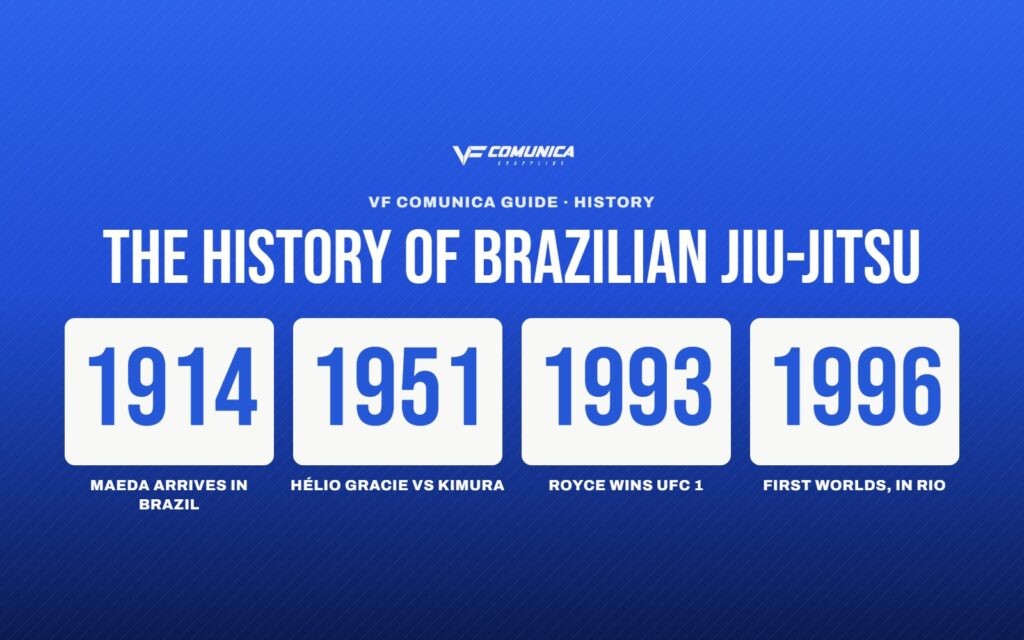
Maeda arrived in Brazil in 1914. There is a record of an exhibition of his in Santos in September of that year, and in December 1915 he gave his first demonstration in Belém, in the state of Pará, where he would end up settling. He died in the city in 1941.

It was in Belém that Carlos Gracie, born in 1902, discovered the art. The traditional version says he was a direct student of Maeda. Researchers who studied the newspapers of the time argue that Carlos’s main teacher was Jacyntho Ferro, a student of the Japanese fighter. The Gracie family moved to Rio de Janeiro in 1921.
The Gracie academy and the challenge matches
Tradition records 1925 as the year of the first Gracie academy, in Rio. More recent research points to 1930, at a school opened by Donato Pires dos Reis, another Maeda student, on Rua Marquês de Abrantes and taken over by the Gracie brothers the following year.
With Carlos and his younger brother Hélio Gracie, the family built the art’s reputation through challenge matches against fighters from other styles. In 1951, Hélio faced two Japanese fighters. He drew with and then beat Kato. In October, at Maracanã stadium, in front of about 20,000 people, he lost to Masahiko Kimura, who submitted him with the shoulder lock still known by the Japanese fighter’s name. In 1955, Hélio fought for more than three and a half hours against his former student Waldemar Santana and lost. His nephew Carlson Gracie faced Santana next and beat him in 1956.
The other lineage: Fadda
The Gracies were not the only ones. Luiz França, who is also described as a Maeda student, taught Oswaldo Fadda, a black belt since 1942. In 1950, Fadda opened an academy in Bento Ribeiro, in Rio’s working-class suburbs, and brought Jiu-Jitsu to people who could not afford classes in the wealthy South Zone. In the 1950s, students of Fadda and of the Gracies met in an academy-versus-academy challenge whose result is told differently by the two lineages.
Belts, a federation and Rolls’s generation
In 1967 the Guanabara Jiu-Jitsu Federation was created, with Hélio Gracie as president, and it set up the first official belt system. The belt order used today comes from that foundation.
In the 1970s, Rolls Gracie opened the training to techniques from wrestling, sambo and judo and produced a generation of champions. He died in 1982, at 31, in a hang-gliding accident.
The UFC and the spread around the world
Rorion Gracie moved to California in 1978 and started out teaching in his garage. He was one of the creators of the UFC, a tournament designed to show how well Jiu-Jitsu worked against other fighting styles. At the first edition, on November 12, 1993, in Denver, his brother Royce Gracie beat three opponents in one night, all by submission. From then on, Jiu-Jitsu academies multiplied in the United States and around the world.
The organized sport
| Year | What happened |
|---|---|
| 1994 | Carlos Gracie Jr. founds the Brazilian Jiu-Jitsu Confederation (CBJJ) |
| 1996 | First World Championship, at Tijuca Tênis Clube in Rio de Janeiro |
| 1998 | The Worlds add women’s divisions; in Abu Dhabi, the first ADCC is held |
| 2007 | The Worlds move to California |
| 2025 | The UFC launches UFC BJJ, with Jiu-Jitsu-only events |
Today the sport has several federations, a professional circuit with prizes of up to US$1 million and a list of world champions that starts in 1996.
Which moment changed Jiu-Jitsu history the most? Leave your opinion in the comments.