



IBJJF, CBJJ, AJP and ADCC: what is the difference between Jiu-Jitsu federations
Jiu-Jitsu has no single governing body: each federation runs its own circuit, with its own ranking, rules and even its own world title; here is who is who and which tournament means what

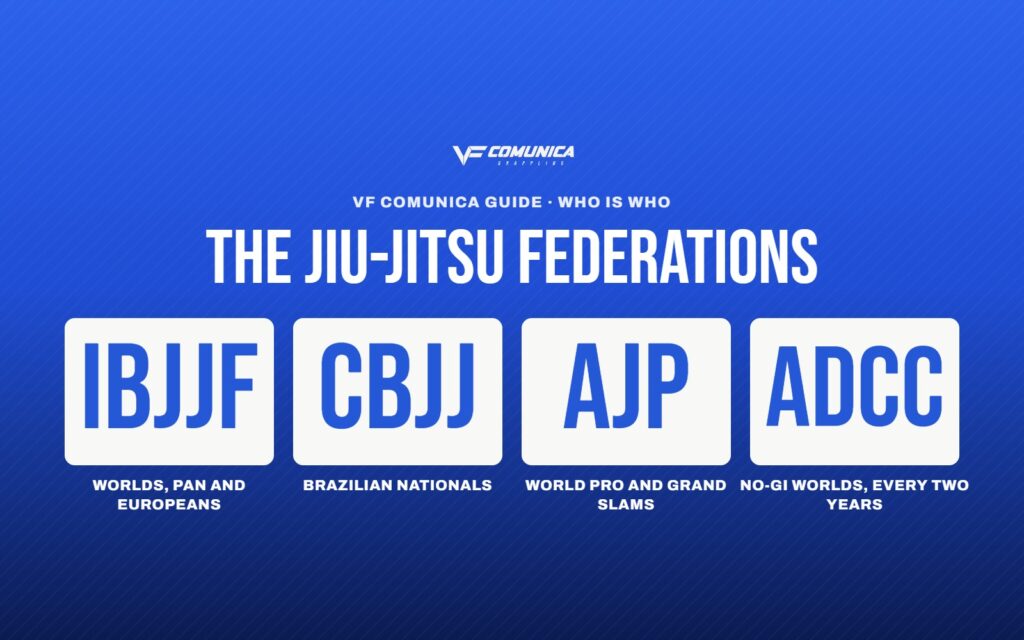
Anyone who starts following Jiu-Jitsu soon runs into an alphabet soup: IBJJF, CBJJ, CBJJE, AJP, PBJJF, SJJIF. Unlike soccer or basketball, the sport has no single governing body. Each federation is independent, sets its own calendar and has its own ranking, rule book and, in several cases, its own world title.
That is why there is more than one “world champion” each year. Here is who is who among the main organizations.
The main acronyms
| Acronym | Name | Main tournaments |
|---|---|---|
| IBJJF | International Brazilian Jiu-Jitsu Federation | Worlds, Pan, Europeans and No-Gi Worlds |
| CBJJ | Brazilian Jiu-Jitsu Confederation | Brazilian Nationals and opens across Brazil |
| AJP | Abu Dhabi Jiu-Jitsu Pro | World Pro and Grand Slams |
| CBJJE | Brazilian Sport Jiu-Jitsu Confederation | Its own Worlds and Pan American, in São Paulo |
| PBJJF | Its own Worlds and opens in Brazil and the United States | |
| SJJIF | Sport Jiu-Jitsu International Federation | Its own Worlds |
| ADCC | Abu Dhabi Combat Club | No-gi world championship, every two years |
IBJJF and CBJJ: the same system
The CBJJ was founded in 1994 by Carlos Gracie Jr., who also leads the IBJJF, its international arm. Both use the same rule book and the same membership system. The CBJJ runs the Brazilian Nationals, held since 1996. The IBJJF runs the Worlds, the Pan and the Europeans.
Together, those four tournaments make up the Jiu-Jitsu Grand Slam. The IBJJF World Championship, held since 1996 and staged in California since 2007, is the title the community treats as the most important in the sport. It is the one behind the list of the greatest world champions of all time.

AJP: the Abu Dhabi circuit
The AJP is the organization tied to the United Arab Emirates federation. Its main tournament is the World Pro, created in 2009 and held every year in Abu Dhabi. Around it is a world tour of Grand Slams, launched in 2015, with stops in several countries. Its weight classes are different from the IBJJF’s, and the tour pays cash prizes at every stop. The 2026 World Pro is set for November.
CBJJE and the other Brazilian confederations
The CBJJE is based in São Paulo and runs its own circuit, with a Pan American, a Worlds and a kids’ Worlds, all in the city of São Paulo. It has its own rule book, with the same basic scoring as the IBJJF, and pays prize money to black belts at its Worlds. A CBJJE world title and an IBJJF world title come from different tournaments.
Brazil also has other national confederations, such as the CBJJO and the CBJJD, and state federations in Rio de Janeiro, São Paulo, Minas Gerais and elsewhere, each with its own championship and ranking.
PBJJF, SJJIF and JJIF
The PBJJF runs opens in Brazil and has been growing in the United States, where it holds its 2026 Worlds in October. The SJJIF was founded in 2011 in Los Angeles and has had its own Worlds since 2013.
The JJIF is something else. It is the international federation of ju-jitsu, a sport of Japanese origin with different rules that is part of the World Games and the Asian Games. One of its disciplines, ne-waza, is the closest to Brazilian Jiu-Jitsu.
What about the ADCC?
The ADCC is not a federation. It is a no-gi submission grappling tournament held every two years, with regional trials and its own rules. The full guide is in what is the ADCC.
Do I need a membership to compete?
Each federation has its own membership. At the IBJJF and the CBJJ it is mandatory to enter their tournaments, is valid for one year and is done through a registered academy, with the approval of the head instructor. An athlete can be a member of more than one organization and compete on several circuits in the same season, which is common among professionals.
The rules also change from one to the other. Before signing up, check the event’s rule book. The VF Comunica guides to scoring, weight classes and illegal moves follow the IBJJF rules.
Should Jiu-Jitsu have a single federation? Leave your opinion in the comments.