




Jiu-Jitsu scoring: how many points each position is worth
Takedown, sweep and knee on belly are worth two points, a guard pass is worth three, mount and back are worth four; see how advantages, penalties and tie-breakers work under IBJJF rules

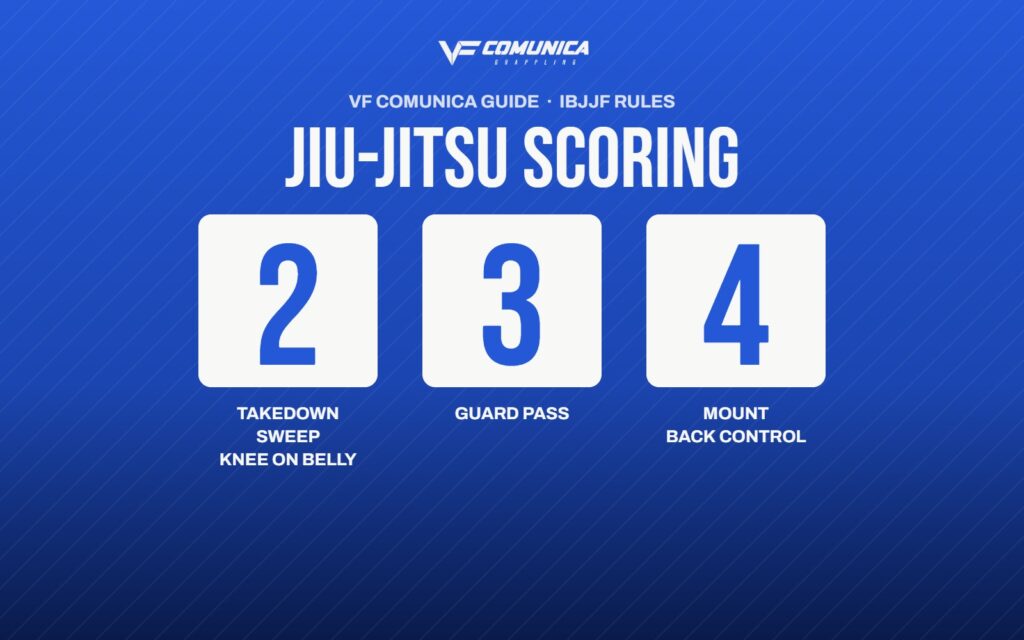
Anyone watching a Jiu-Jitsu match for the first time tends to get lost on the scoreboard. There are three numbers for each athlete, the referee makes a different signal for every move and, sometimes, the match ends tied on points and still has a winner. The logic is in the rule book of the IBJJF, the sport’s international federation, used as a reference at most championships.
Below: how many points each position is worth, what an advantage is, how penalties work and the order of the tie-breakers.
How many points each position is worth
| Position | Points |
|---|---|
| Takedown | 2 |
| Sweep | 2 |
| Knee on belly | 2 |
| Guard pass | 3 |
| Mount | 4 |
| Back mount | 4 |
| Back control | 4 |
The chart follows an idea of progression: the closer a position puts the athlete to a submission, the more it is worth. That is why the mount and the back, the positions with the most control, pay twice as much as a takedown.
The three-second rule
Getting to the position is only half the job. The rule book states that points are awarded when the athlete stabilizes the position for three seconds. Without that control, the referee does not raise an arm.
Points are cumulative. The rule book itself gives the example: a guard pass followed by a mount adds up to seven points, three plus four. An athlete caught in a submission attempt only scores after escaping the attack and stabilizing the position.
Each position has its requirements. In the mount, the athlete must be on top, sitting on the opponent’s torso, with two knees or one foot and one knee on the ground. On the back, the heels must be between the opponent’s thighs, without crossing the legs.
What an advantage is
The advantage is the second number on the scoreboard. It is given when the athlete reaches a scoring position and cannot hold it for three seconds, or locks in a submission attempt that puts the opponent in real danger. The referee can award an advantage even after time runs out, before announcing the result.
The rule book has one exception: sweeps that start and end in the 50/50 guard earn no advantage.
Penalties: from a warning to disqualification
The third number is for penalties. For serious fouls and lack of combativeness, known as stalling, the sequence is the same:
- 1st penalty: marked on the scoreboard
- 2nd penalty: advantage to the opponent
- 3rd penalty: two points to the opponent
- 4th penalty: disqualification
For stalling, the referee counts 20 consecutive seconds without the athlete trying to progress before penalizing. Stalling and serious foul penalties are added together. The 20-second window also applies when both athletes pull guard at the same time: if nobody comes up, both are penalized and the match restarts standing.
Fleeing the match area costs a penalty and two points to the opponent. And since the 2024 update, there is a limit for the 50/50 guard with a lapel or belt grip: the athlete has 20 seconds to progress or is penalized.
Who wins when the score is tied
A match can end early by submission, stoppage, disqualification or loss of consciousness. If it goes the distance, the athlete with more points wins. With equal points, advantages decide. If it is still tied, the athlete with fewer penalties wins. Only then does the decision go to the referee.
Gi and no-gi use the same scoreboard
The points chart is the same for both. What changes in no-gi are the grips and some of the legal techniques, the subject of another VF Comunica guide. Match time varies by belt and age: see how long a Jiu-Jitsu match is.
Events such as the ADCC and professional invitationals have their own rules, with criteria different from the IBJJF’s.
Which Jiu-Jitsu rule would you change? Leave your opinion in the comments.