



Jiu-Jitsu weight classes: the IBJJF chart
From rooster to ultra heavy, see the limit of each male and female weight class, gi and no-gi, and how the weigh-in works at championships

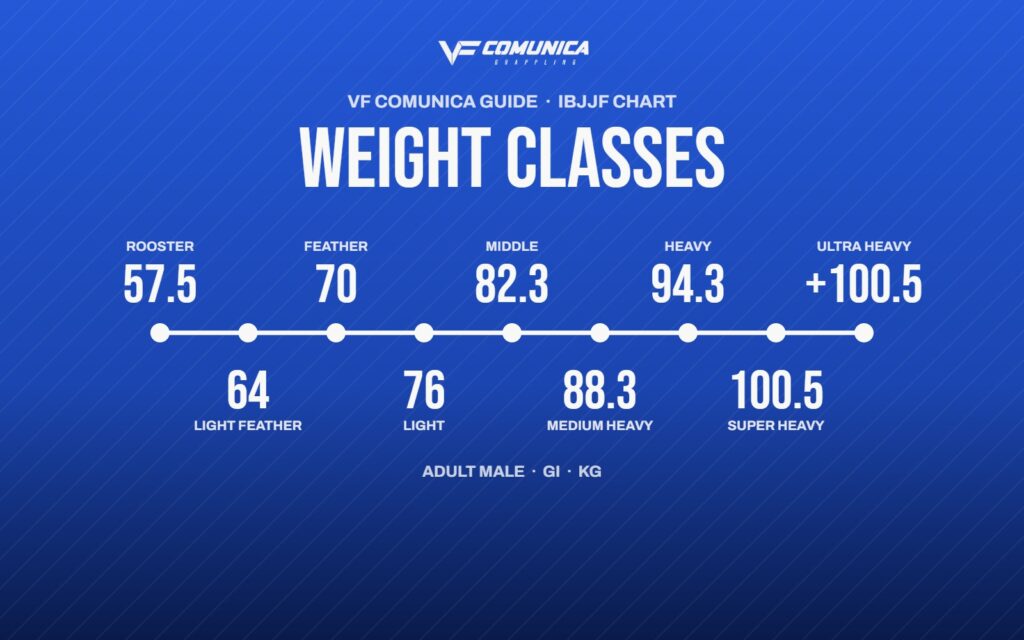
Choosing a weight class is one of the first decisions for anyone who wants to compete in Jiu-Jitsu. In the IBJJF, the adult male division has nine weight classes and the female division has eight, with different charts for gi and no-gi. The limits below apply to every adult belt and also to the master divisions.
The numbers show the maximum weight for each class. Anyone over the limit, even by a few grams, is out.
Male weight classes
| Weight class | Gi | No-gi |
|---|---|---|
| Rooster | 57.5 kg (127.0 lb) | 55.5 kg (122.6 lb) |
| Light feather | 64 kg (141.6 lb) | 61.5 kg (136 lb) |
| Feather | 70 kg (154.6 lb) | 67.5 kg (149 lb) |
| Light | 76 kg (168.0 lb) | 73.5 kg (162.6 lb) |
| Middle | 82.3 kg (181.6 lb) | 79.5 kg (175.6 lb) |
| Medium heavy | 88.3 kg (195.0 lb) | 85.5 kg (188.6 lb) |
| Heavy | 94.3 kg (208.0 lb) | 91.5 kg (202 lb) |
| Super heavy | 100.5 kg (222.0 lb) | 97.5 kg (215 lb) |
| Ultra heavy | No limit | No limit |
Female weight classes
| Weight class | Gi | No-gi |
|---|---|---|
| Rooster | 48.5 kg (107.0 lb) | 46.5 kg (103 lb) |
| Light feather | 53.5 kg (118.0 lb) | 51.5 kg (114 lb) |
| Feather | 58.5 kg (129.0 lb) | 56.5 kg (125 lb) |
| Light | 64 kg (141.6 lb) | 61.5 kg (136 lb) |
| Middle | 69 kg (152.6 lb) | 66.5 kg (147 lb) |
| Medium heavy | 74 kg (163.6 lb) | 71.5 kg (158 lb) |
| Heavy | 79.3 kg (175.0 lb) | 76.5 kg (169 lb) |
| Super heavy | No limit | No limit |
In the female division, the chart ends at super heavy, which includes every athlete above the heavyweight limit.
Why the gi counts
In gi championships, athletes step on the scale dressed to fight, wearing the gi and belt. In no-gi tournaments, the weigh-in is done in the no-gi uniform. That explains the gap between the two charts, which ranges from 2 kg to 3 kg depending on the class.

In practice, gi competitors have to include the weight of the uniform in their math. A lighter or heavier gi can be the difference between making weight and being out of the bracket.
How the weigh-in works
The official weigh-in takes place immediately before the athlete’s first match, not the day before, as in other combat sports. There is only one attempt. Anyone who steps on the scale over the limit is disqualified on the spot, with no option to change divisions and no refund of the registration fee.
Because the match comes right after the scale, aggressive weight cuts are costly in Jiu-Jitsu: there is no time to rehydrate before stepping on the mat.
Open class, juveniles and kids
Besides the weight classes, championships have the open class, also known as the absolute, with no weight limit. Juveniles and kids have their own charts, with lower limits, set by the IBJJF for each age group.
At professional events, the weights change
Invitationals usually have fewer divisions. The IBJJF’s The Crown is held in four male weight classes (feather, middle, heavy and ultra heavy) and two female classes (light and super heavy). As a result, some athletes have to move up or down in weight to enter the bracket.
Which weight class do you compete in? Tell us in the comments.